Sunday, March 29, 2020

TOGAF ADM - Preliminary Phase

Preliminary Phase

This phase describes the preparation and initiation activities required to meet the business directive for a new Enterprise Architecture, including the definition of an Organization-Specific Architecture framework and the definition of principles.

Objectives

Please refer TOGAF ADM Preliminary Phase

Inputs

  1. Reference Materials External to the Enterprise
    1. The TOGAF Library
    2. Other architecture framework
      1. Architecture Framework
        1. MOD Architecture Framework (MODAF)
        2. Kruchten's 4+1 View Model
        3. Reference Model of Open Distributed Processing (RM-ODP)
      2. Enterprise Architecture Framework
        1. PRISM
        2. NIST Enterprise Architecture Model (unable to locate the original document)
        3. Enterprise Architecture Planning (EAP) (unable to locate the original document)
        4. Technical Architecture Framework for Information Management (TAFIM) (unable to locate the original document)
        5. Zachman Framework
  2. Non-Architectural Inputs
    1. How strategic planning relates to enterprise architecture
  3. Architectural Inputs
    1. Organizational Model
      1. 5 Types of Organizational Models
      2. Maturity assessment
      3. Roles & Responsibilities
      4. Budget Requirements
      5. Governance & Support Strategy
    2. Existing Architecture Framework (if any)
      1. Architecture Method: a structured collection of techniques which can be used to guide processes to achieve a particular goal.
      2. Architecture Content: deliverables, artefacts, and building blocks
      3. Configured and Deployed Tools
      4. Architecture Principles: business, data, application, and technology
      5. Architecture Repository: Architecture Metamodel, Architecture Capability, Architecture Landscape, Standards Information Base, Reference Library, and Governance Log

Steps

Outputs

  1. Request for Architecture Work (optional)

Approach

Management Framework

Enterprise Architecture Maturity Model

NASCIO EAMM

TOGAF - Architecture Development Method (ADM)

Architecture Development Method (ADM)

The TOGAF ADM provides a tested and repeatable process for developing architectures. The ADM includes establishing an architecture framework, developing architecture content, transitioning, and governing the realization of architectures.

All of these activities are carried out within an iterative cycle of continuous architecture definition snd realization that allows organisations to transform their enterprises in a controlled manner in response to business goals and opportunities.

ADM Phases

TOGAF v9.2

The TOGAF® Standard, Version 9.2 Overview

The TOGAF® Standard, a standard of The Open Group, is a proven Enterprise Architecture methodology and framework used by the world's leading organizations to improve business efficiency. It is the most prominent and reliable Enterprise Architecture standard, ensuring consistent standards, methods, and communication among Enterprise Architecture professionals. Those fluent in the TOGAF approach enjoy greater industry credibility, job effectiveness, and career opportunities. The TOGAF approach helps practitioners avoid being locked into proprietary methods, utilize resources more efficiently and effectively, and realize a greater return on investment.

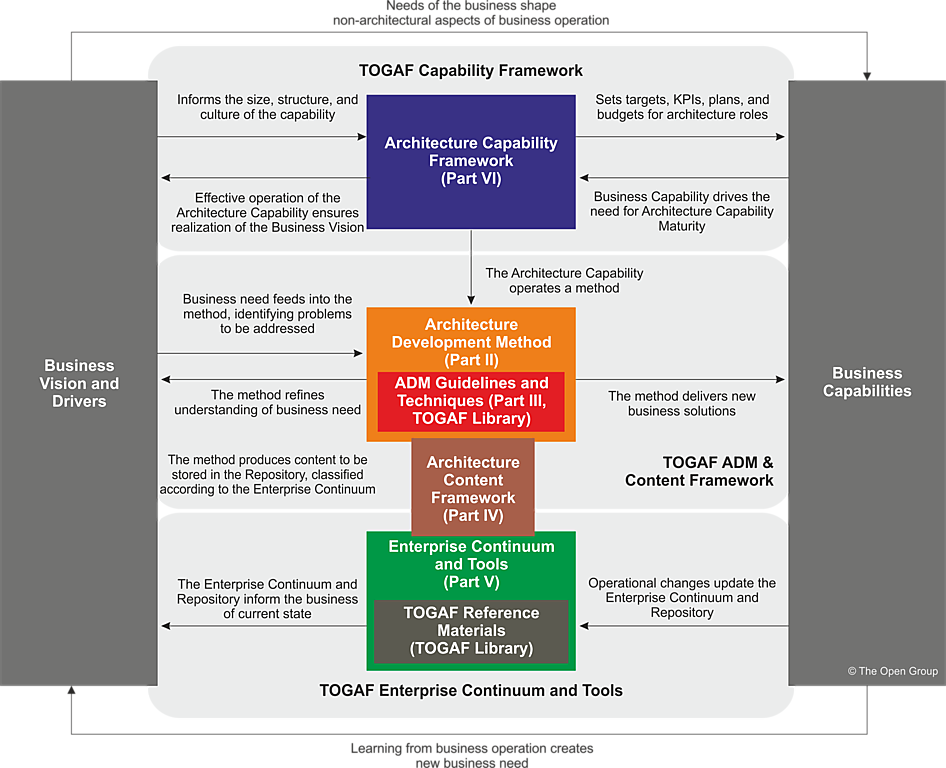
Structure of TOGAF Standard

  • TOGAF Capability Framework
  • TOGAF ADM and Content Framework
  • TOGAF Enterprise Continuum & Tools
figure 1: Structure of the TOGAF Standard

Enterprise Architecture - References


Figure 1. The Relationship between TOGAF, IT4IT, ArchiMate, and ITIL.


Wednesday, June 12, 2019

Initial Data Analysis (IDA)

Reference
Introduction
  • IDA aims to inspect and inject data prior to main data analysis stage.
  • Stages:
    1. Data quality check
    2. Data transformation
    3. Data randomization
    4. Data characteristics documentation

Data Quality Check
  • Assessment types:
    1. Frequency counts
    2. Descriptive statistics (mean, standard deviation, median)
    3. Normality (skewness, kurtosis, frequency histograms)
  • Types of Data issue:
    1. Duplicate record
    2. Inconsistent date and time stamps
    3. Outliers
    4. Missing values

Data Transformation
  • Assessment types:
    1. Square root transformation
    2. Log-transformation
    3. Inverse transformation
    4. Make categorical

Data Randomization
  • Randomize the data and prove that sample data agree with the original intentions
  • Methods:
    1. Generate random permutation of the data
    2. Select random sample of the data

Data Characteristics Documentation
  • Changes (modified/removed/manipulated) to the original data
  • Shape of the distribution of variables
  • Error rates/patterns
  • Criteria to detect abnormality

Wednesday, May 22, 2019

Python Dictionary

Links: Journey to Data Scientist


Characteristics
  • Unordered (followed the sequence the keys were added)
  • Mutable
  • Can be nested
  • Access via key

#create an empty dictionary
d = {}
print(type(d))

Output: <class 'dict'>


d = {'key1':'value1',2:'value2',0.01:201}
print(d)
print(d['key1'])
print(d[2])
print(d[0.01])

Output:
{'key1': 'value1', 2: 'value2', 0.01: 201}
value1
value2
201


d[2] = 'update value'
print(d[2])

Output: update value


for k, v in d.items():
  print(k, ":", v)

Output:
key1 : value1
2 : update value
0.01 : 201


if 'key1' in d:
  print(d['key1'])

Output: value1


d['add'] = 1990
print(d)

Output: {'key1': 'value1', 2: 'update value', 0.01: 201, 'add': 1990}


d.pop('add')
print(d)

Output: {'key1': 'value1', 2: 'update value', 0.01: 201}


print(d)
d.clear()
print(d)

Output:
{'key1': 'value1', 2: 'value2', 0.01: 201}
{}


Tuesday, May 21, 2019

Python Sets

Links: Journey to Data Scientist


Characteristics
  • Unordered
  • Hashable
  • Unique
  • Immutable
  • Support mathematical operations like union, intersection, difference, and symmetric difference

1. Unordered (in fact, output is ordered by hashed value)
Example #1
s = {"abc",123,9.99,"DEF",3.142,100}
print(s)
print(type(s))

Output:
{3.142, 100, 9.99, 'abc', 'DDf', 123}
<class 'set'>

Example #2
s = s = {"abc","123","9.99","DDf","3.142","100"}
print(s)
print(type(s))

Output:
{'100', 'abc', 'DDf', '3.142', '9.99', '123'}
<class 'set'>

Example #1 and #2 above show different ordering of output compare to their original definition. This is because Python will hash the elements first. Different data type will use different algorithm.


2. Common Operations
s = set() #empty set
print(s)
s = {"abc",123,9.99,"DDf",3.142,100} #100 will be the first one to be pop-ed
print(s)
print("Length of s: ",len(s)) #number of element in set
s.add("one item") #add one element
print("Added 'one item':",s)
s.update(("i1","i2","i3")) #add multiple items
print("Updated 'i1, i2, i3':",s)
s.remove(3.142)
print("Removed 3.142: ",s)
s.discard(99999) #this will not trigger error
print("Discarded 99999 (no effect): ",s)
s.discard("DDf")
print("Discarded DDf: ",s)
s.pop()
print("Poped last item (in original definition): ",s)
s.clear() #make it an empty set
print(s)

s.remove(99999) #this will trigger error because 99999 does not exist in the set
del s #this will release 's' from memory, this variable will become undefined

Output:
set()
{3.142, 100, 9.99, 'abc', 'DDf', 123}
Length of s: 6
Added 'one item': {3.142, 100, 'one item', 9.99, 'abc', 'DDf', 123}
Updated 'i1, i2, i3': {3.142, 100, 'one item', 'i2', 9.99, 'abc', 'DDf', 'i1', 123, 'i3'}
Removed 3.142: {100, 'one item', 'i2', 9.99, 'abc', 'DDf', 'i1', 123, 'i3'}
Discarded 99999 (no effect): {100, 'one item', 'i2', 9.99, 'abc', 'DDf', 'i1', 123, 'i3'}
Discarded DDf: {100, 'one item', 'i2', 9.99, 'abc', 'i1', 123, 'i3'}
Poped last item (in original definition): {'one item', 'i2', 9.99, 'abc', 'i1', 123, 'i3'}
set()


2. Mathematical Operations
s1 = {1,3,4,8,9}
s2 = {5,7,6,8,9}

print("Difference: ",s1.difference(s2))
print("Intersection: ",s1.intersection(s2))
print("IsDisjoint: ",s1.isdisjoint(s2))
print("IsSubSet: ",s1.issubset(s2))
print("IsSuperSet: ",s1.issuperset(s2))
print("Symmetric Difference: ",s1.symmetric_difference(s2))
print("Union: ",s1.union(s2))

Output:
Difference: {1, 3, 4}
Intersection: {8, 9}
IsDisjoint: False
IsSubSet: False
IsSuperSet: False
Symmetric Difference: {1, 3, 4, 5, 6, 7}
Union: {1, 3, 4, 5, 6, 7, 8, 9}

s1 = {1,3,4,8,9}
s2 = {5,7,6,8,9}

s1.difference_update(s2)
print("After Difference Update: ",s1)

Output: After Difference Update: {1, 3, 4}

s1 = {1,3,4,8,9}
s2 = {5,7,6,8,9}

s1.intersection_update(s2)
print("After Intersection Update: ",s1)

Output: After Intersection Update: {8, 9}

s1 = {1,3,4,8,9}
s2 = {5,7,6,8,9}

s1.symmetric_difference_update(s2)
print("After Symmetric Difference Update: ",s1)

Output: After Symmetric Difference Update: {1, 3, 4, 5, 6, 7}

Wednesday, May 15, 2019

Python Tuples

Links: Journey to Data Scientist


Characteristics
  • Ordered
  • Can contain arbitrary objects
  • Accesible via index
  • Can be nested
  • Immutable

It shares most of the characteristics as Lists except it is immutable.
Therefore, operations on Tuples are faster than Lists (when number of elements is getting larger)

Immutable
t = ("apple","moon","3",57,9.99,0x3e)
print(t)
print(t[1])
print(t[3:6])
print(t[::4])

Output:
('apple', 'moon', '3', 57, 9.99, 62)
moon
(57, 9.99, 62)
('apple', 9.99)

If we try to modify the value:
t[0] = "orange"
Output:
--------------------------------------------------------------------------
TypeError Traceback (most recent call last)
<ipython-input-9-9456d7af7fd3> in <module>
----> 1 t[0] = "orange"

TypeError: 'tuple' object does not support item assignment

Unpacking Tuples
t = ("apple","moon","3",57,9.99,0x3e)
(u1,u2,u3,u4,u5,u6) = t
print(u1,u2,u3,u4,u5,u6)

Output: apple moon 3 57 9.99 62